PEA
PEA in SciatiEase: What 500 mg of Palmitoylethanolamide Can and Cannot Do
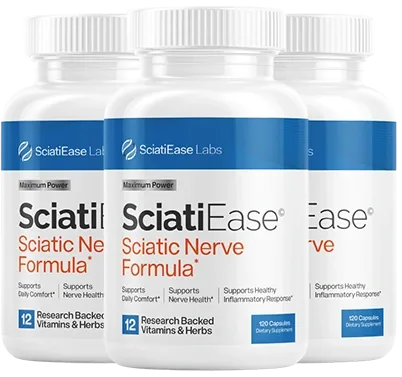
PEA in SciatiEase comes to 500 mg per 4-capsule serving, the largest single amount on the label. Pain trials used 300-1,200 mg a day, and one sciatica trial found 600 mg did better than 300 mg. Those studies were small and short, and nobody has tested PEA inside SciatiEase itself.
Written by the SciatiEase label deskUpdated
What it is01
What is PEA in SciatiEase?
PEA, short for palmitoylethanolamide, is a fatty acid amide your body makes on its own. It belongs to a family of signaling molecules often called endocannabinoid-like.
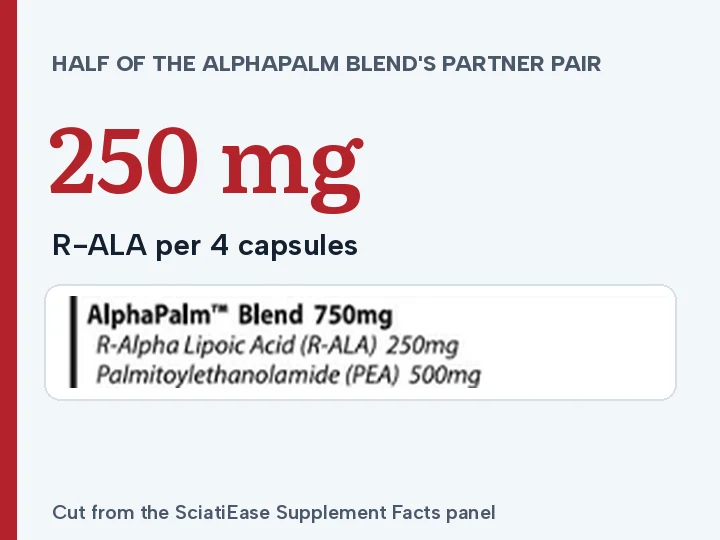
In SciatiEase it shares the AlphaPalm Blend line with R-alpha lipoic acid. Unlike many blends, the label prints the PEA amount: 500 mg in every 4-capsule serving.
In Europe, PEA is sold as a food for special medical purposes. In the US it shows up in dietary supplements like this one, which means no FDA review before sale (FDA, Using Dietary Supplements).
Researchers study it because the body seems to use it to damp pain and inflammation signals. That is the theory. The useful question is what happened when people swallowed it.
The dose02
How much PEA is in a SciatiEase serving?
Four capsules hold 500 mg of PEA. Two capsules hold 250 mg.
That makes PEA the biggest single ingredient on the panel, ahead of R-ALA and acetyl-L-carnitine at 250 mg each. The table below lines the label up with the research.
The split matters. The sales page starts people on 2 capsules with breakfast (SciatiEase sales page). At that level you get 250 mg, which sits under the lowest dose in the trials. The full serving of 4 reaches the lower half of the studied range.
| Name on the label | Palmitoylethanolamide (PEA) |
|---|---|
| What it is | A fatty acid amide the body makes; part of the endocannabinoid-like signaling family |
| Place on the label | Inside the 750 mg AlphaPalm Blend, amount printed |
| Amount per 4 capsules | 500 mg per 4 capsules |
| Amount per 2 capsules | 250 mg |
| Amount used in research | 300-1,200 mg a day across 11 pain trials; 300 or 600 mg a day in one sciatica trial |
| Strength of evidence | Small, mostly short trials suggest less pain; quality varies |
| Marketed or traditional use | Sold in Europe as a food for special medical purposes |
| Main caution | Well tolerated in studies; long-term data are thin. |
Sciatica trial03
Does PEA help sciatica?
One large trial suggests it may ease sciatic pain, and the higher dose did better. The trial has real limits, so treat it as a lead, not proof.
The study enrolled 636 people with sciatic pain from a pressed nerve root. They took PEA at 300 mg a day, 600 mg a day or a placebo for 3 weeks (Keppel Hesselink, J Pain Res 2015).
A later look at the data counted how many people needed the pill for one extra person to reach 50% less pain. That number was 6.5 at 300 mg and 1.5 at 600 mg. Lower is better, so the 600 mg group fared far better.
A second trial of 111 people also found 600 mg a day worked best in its comparison (Keppel Hesselink, J Pain Res 2015). SciatiEase gives 500 mg at the full serving, between the two arms of the big trial.
| Group | PEA a day | People treated for one extra 50% responder |
|---|---|---|
| Trial, lower arm | 300 mg | 6.5 |
| Trial, higher arm | 600 mg | 1.5 |
| SciatiEase, 2 capsules | 250 mg | Not tested |
| SciatiEase, 4 capsules | 500 mg | Not tested |
Wider research04
What do PEA pain studies show overall?
A 2023 meta-analysis pooled 11 double-blind trials and found lower pain scores with PEA than with the comparison treatments.
The trials covered 774 patients with long-lasting pain of several kinds. Doses ran from 300 mg to 1,200 mg a day. No study in the review blamed a major side effect on PEA (Lang-Illievich et al., Nutrients 2023).
The authors still asked for more work on the best dose. Pooled results can hide weak single studies, and pain is easy to nudge with expectation.
Trials
All double-blind and randomized, pooled in one review.
Patients
People with chronic pain, not only sciatica.
mg a day
The dose range tested. SciatiEase gives 500 mg.
Safety05
Is PEA safe to take every day?
In trials lasting weeks, PEA caused few problems. Long-term safety rests mainly on lab and animal tests.
A review of eight trials with 1,366 patients described no troublesome side effects or drug interactions (Keppel Hesselink, J Pain Res 2015). Lab tests found no gene damage, and rats given up to 1,000 mg per kg each day for 90 days showed no ill effect (Nestmann, Food Sci Nutr 2017). Those are not human data.
The bigger cautions in SciatiEase come from other lines, such as feverfew with blood thinners and the 20 mg of B6. Read the side effects guide before you start.
Do not stop or lower a pain or nerve medicine because you added PEA. Ask the prescriber first.
SciatiEase: from $49.99 a bottle120 capsules · 1, 3 or 6 bottles · free US shipping on 3 or 6 · 180-day guarantee
See packsFair limits06
What are the weak spots in the PEA research?
Small and short studies, one key trial published only in Spanish, and no test of the SciatiEase formula.
The 636-person trial appeared in a Spanish journal, and its strongest number came from an analysis done after the fact (Keppel Hesselink, J Pain Res 2015). That kind of finding needs repeating before anyone leans on it.
- Most trials ran for weeks, not months
- Trial quality varied across the meta-analysis
- Single-ingredient results may not carry over to a 12-line mix (FTC, Health Products Compliance Guidance)
In the formula07
How does PEA fit with the other SciatiEase ingredients?
It carries most of the weight. The other actives were studied mainly in diabetic nerve damage, not sciatica.
PEA sits beside R-alpha lipoic acid in the AlphaPalm line. The B vitamins, carnitine and benfotiamine round out the panel.
If PEA is the part you care about, the useful habit is simple: take the full 4 capsules, give it a few weeks, and track how far you walk. Guidelines still put movement first for sciatica; see relief options.
More ingredients08
Which other nerve supplement ingredients are in SciatiEase?
Seven more profiles cover the rest of the panel, from R-ALA to the herb blend.
Each one shows the label amount, the studied dose and the main caution. The full list is on the supplement facts page.
FAQ09
PEA questions
How much PEA do 2 SciatiEase capsules give?
Two capsules give 250 mg of PEA, half the 500 mg in the full 4-capsule serving. That is below the 300 mg low arm of the sciatica trial (Keppel Hesselink, J Pain Res 2015), so the full serving is closer to studied doses.
What PEA dose was studied for sciatica?
The main trial tested 300 mg and 600 mg a day against placebo for 3 weeks in 636 people (Keppel Hesselink, J Pain Res 2015). The 600 mg dose did better. A smaller trial of 111 people also favored 600 mg.
How long did PEA take to help in the sciatica trial?
The trial ran 3 weeks, and results were measured at that point (Keppel Hesselink, J Pain Res 2015). That does not promise a timeline for SciatiEase, which has its own mix and has never been tested as a product.
Is PEA a prescription drug?
No. In Europe it is sold as a food for special medical purposes. In the US it appears in dietary supplements such as SciatiEase, which the FDA does not approve before sale (FDA, Using Dietary Supplements).
Does PEA have side effects?
Few were reported. Across 11 double-blind trials, no major side effect was blamed on PEA (Lang-Illievich et al., Nutrients 2023). Long-term data in people are thin; the deeper safety work was done in rats and lab tests (Nestmann, Food Sci Nutr 2017).
Why does the brand website list 600 mg of PEA?
The brand home page lists 600 mg, but the Supplement Facts panel prints 500 mg per 4 capsules (SciatiEase order page). We follow the panel because it describes what is in the bottle.
Who wrote this10
Written and reviewed by
Pages built from the label, the brand pages and linked NIH, FDA, FTC, NICE and peer-reviewed sources.
Last updated . How we work: editorial standards and how we check reviews. This website is run by a licensed SciatiEase retailer, not by the manufacturer, SciatiEase Labs. We earn money when you buy through our order links.
Keep reading
More about SciatiEase
Licensed SciatiEase retailer
Ready to try SciatiEase?
Look over your medicines first, then choose a pack. Three or six bottles ship free in the US and cost less per bottle, and the 180-day guarantee covers every pack.
- Secure checkout on the brand page
- 180-day guarantee
- Ships from the U.S.